
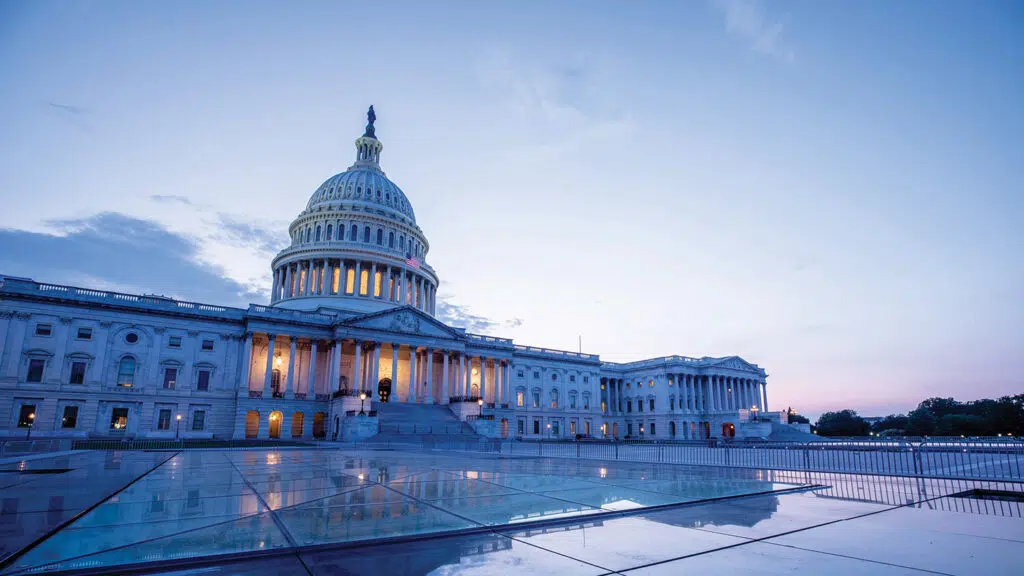
Washington entered a partial government shutdown at midnight on Jan. 31, 2026 after funding lapsed for dozens of federal agencies. The Senate advanced a bipartisan funding package late Friday to fund most of the government, but the House had not approved it when funding expired. Many agencies are expected to return to normal once the House votes, but the current impasse highlights structural fractures in federal governance that matter to every executive responsible for risk and technology.
This shutdown was avoidable, but negotiators were unable to bridge differences over funding for the Department of Homeland Security and conditions tied to immigration enforcement reforms. A short-term agreement was reached to extend DHS funding for two weeks to allow time for further talks, but the lack of alignment between chambers has delayed final action, increasing the likelihood that the shutdown extends beyond initial expectations.
Why Shutdowns Matter More Than It Appears
Shutdowns are often dismissed as procedural disruptions that resolve themselves with minimal lasting impact. That assumption is increasingly risky.
When funding lapses are driven by unresolved policy disputes rather than simple budget mechanics, resolution timelines become less predictable. Repeated or prolonged disruptions quietly erode operational capacity, particularly in areas where continuity, coordination and tempo are essential.
Cybersecurity sits squarely in that category. During the multi-week shutdown in late 2025, the Department of Defense was reported to have used unobligated Research and Development funds to pay military personnel in lieu of appropriate appropriated funds. Rather than draw from an Operations and Maintenance account, DoD seems to have tapped billions in existing R&D budgets to sustain payroll obligations during the shutdown. The move drew scrutiny because using R&D money for payroll can violate federal appropriations law and represents a reallocation of innovation funding toward basic operations.
That example underscores a broader point: in a funding lapse federal administrators are often forced to shift money away from long-term capability building toward sustaining essential functions. R&D budgets are among the most common sources that agencies can legally or creatively draw on when there are no other available appropriated funds. This disrupts planned research, delays product development cycles, halts grant reviews and delays deployment of emerging technologies that many organizations depend on.
In cybersecurity specifically, this kind of reallocation affects threat intelligence research, vulnerability assessment programs and tooling innovation that rely on steady R&D investment. When those investments are interrupted or diverted, it weakens the overall ecosystem of public-private collaboration, slows release of shared threat indicators and reduces the pace at which new defensive technologies reach deployment.
What Actually Happens To Cyber Operations During A Shutdown
Federal cyber operations do not stop during a shutdown, but they do narrow.
Agencies such as the Cybersecurity and Infrastructure Security Agency remain operational and focused on incident response and protection of critical infrastructure. What slows or pauses is the work designed to prevent incidents in the first place. Proactive threat hunting, system hardening, cross-sector exercises, contractor-supported initiatives and forward-looking analysis are all reduced.
This dynamic is compounded by a prolonged leadership gap at CISA. The agency has been without a Senate-confirmed director for nearly a year, and efforts to confirm Sean Plankey as director have stalled repeatedly in the Senate. Plankey was first nominated to lead CISA in March 2025 and has been renominated in early 2026, but the agency has operated without a permanent leader throughout this period. That absence matters because cybersecurity does not thrive in strategic drift. Without a confirmed leader, decision-making slows, prioritization becomes more cautious and long-term initiatives are more likely to be deferred in favor of sustaining essential operations.
Cybersecurity shifts from preventive to reactive. Attacks are still detected, but often later, with less context and fewer resources available to contain them quickly.
At the same time, intelligence sharing across agencies and with the private sector becomes less fluid. Advisories slow. Coordination weakens. These are subtle degradations, but adversaries recognize them immediately.
No CMMC Relief
One of the most persistent myths during a shutdown is that compliance expectations pause. They do not. Defense contractors, regulated service providers and enterprises supporting government workloads remain fully accountable for security requirements. Oversight activity may slow. Clarifications may be delayed. Enforcement does not disappear. It accumulates.
This dynamic is especially pronounced in 2026 as Cybersecurity Maturity Model Certification enforcement moves from planning to execution. Phase 1 of CMMC 2.0, which took effect in November 2025 and runs through November 2026, requires contractors at Levels 1 and 2 as applicable by contract to complete self-assessments, executive affirmations and documentation in the Supplier Performance Risk System as a condition of doing business. Phase 2, beginning in November 2026, introduces mandatory third-party certification for Level 2 environments.
The most recent shutdown made this clear. CMMC requirements continued to appear in contracts even as agency staffing and guidance slowed. Obligations remained in force while clarification became harder to obtain, increasing the likelihood of misinterpretation and post-shutdown enforcement findings.
When funding resumes, reviews resume aggressively. Documentation gaps, deferred controls and delayed investments are not forgiven retroactively. Shutdowns compress risk. They do not eliminate it.
For boards and executive teams, this is no longer just a compliance issue. It is a governance and fiduciary issue. Directors retain responsibility for cyber risk oversight regardless of funding disruptions. A shutdown does not create a defensible explanation for missed controls or incomplete documentation.
Why This Shutdown Is More Concerning Than The Last One
Cybercriminal groups and hostile nation-states track political calendars closely. Shutdowns signal reduced staffing, slower coordination and distracted leadership, creating conditions adversaries are quick to exploit.
Historically, shutdown periods have aligned with spikes in phishing campaigns impersonating government agencies, credential harvesting targeting contractors and opportunistic ransomware attacks aimed at municipalities and healthcare providers. This pattern is not accidental. It reflects deliberate exploitation of timing and diminished coordination.
The most recent major shutdown already demonstrated how quickly federal cyber coordination can degrade. What has changed since then is the threat environment itself. Ransomware operations are now more professionalized. Nation-state campaigns are more persistent. Artificial intelligence has lowered the barrier for phishing, reconnaissance and social engineering at scale, allowing attackers to operate faster and with greater reach.
At the same time, many organizations are operating with leaner IT and security teams after years of cost discipline. There is less redundancy, less buffer and less tolerance for disruption. The system is under greater stress at precisely the moment threats are more capable.
If this shutdown extends or repeats in short cycles, the cumulative impact becomes harder to unwind. Modernization efforts stall. Technical debt grows. Essential staff burn out. Contractor disengagement erodes continuity. Temporary workarounds quietly become permanent risk.
Cyber failures rarely stem from a single dramatic decision. They emerge from sustained friction, deferred action and the gradual normalization of degraded conditions.
What Leaders Should Keep In Mind Right Now
First, assume federal coordination will be slower and validate whether your security posture holds up without it.
Second, do not confuse silence with safety. Fewer advisories do not mean fewer threats. They often mean reduced visibility.
Third, maintain discipline. Shutdowns are when deferred patches, delayed reviews and relaxed controls quietly creep in and linger long after funding resumes.
Fourth, treat resilience as an operational requirement, not a compliance checkbox.
Finally, if you are a DOD contractor or subcontractor, assume that CMMC Phase 1 enforcement remains active throughout 2026 and that Phase 2 certification deadlines are approaching, even if agency responsiveness is uneven during a shutdown. Organizations that wait for clarity will find themselves behind those that prepared during uncertainty.
This government shutdown will end. They always do. What matters is not when it ends, but what it exposes. Cybersecurity is not a static capability. It is an operational discipline that must function under stress, uncertainty and disruption. The organizations that emerge strongest are those that do not assume stability, but design for interruption. In today’s threat environment, that distinction separates resilience from regret.
This article was originally published on Forbes by Emil Sayegh on February 1, 2026: The Cybersecurity Consequences of the Latest Government Shutdown